


Text by Krista Balode
Ineta Freidenfelde is a Latvian artist born in the 1970s, who graduated from Liepāja College of Applied Arts, studied scenography and painting at the Latvian Academy of Arts, and belongs to the generation of artists who began their art studies at college during the Soviet era, but completed them in independent Latvia. When asked about this period, the artist admits that in the 1990s, changes in art occurred gradually, when “a new system had not really emerged, because everything did not collapse in one day”, but the field of possibilities inevitably changed. The door to international exchange opened, and Ineta Freidenfelde was one of those students who supplemented her knowledge at the Amsterdam Summer University.
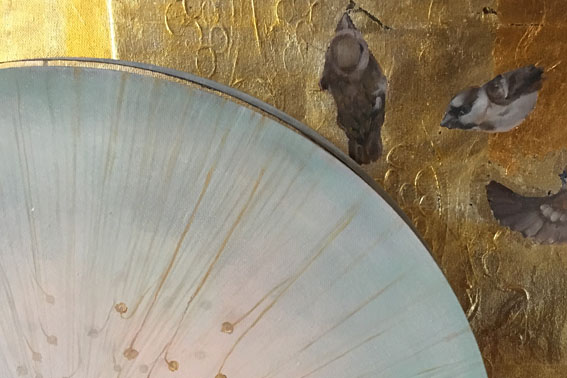
In general, Ineta Freidenfelde’s painting is characterized by an active use of natural motifs, as well as symbols that are repeated from work to work and accumulate in work cycles. Such meaningful symbols in the artist's work include the female body, shoes, birds, ornaments, characters, as well as plants. The artist is also characterized by various searches for technical solutions - games with form and format, painting on wooden boards and elements of the icon painting technique, for example, the use of a gold background. One of the artist's important themes is the depiction of living nature and its interaction with humans. She believes that the basis of many people's negligent attitude towards nature is an incorrect value system, which results in its ruthless pollution.
However, Ineta Freidenfelde's works do not show this pollution or incorrectness to their viewer. On the contrary, the works capture the beauty, tenacity and independence of nature, the rejection of the anthropocentric view is expressed directly through the praise of nature.
Such a critical approach to human lifestyle trends fits into the common understanding of environmental ethics, which as a subfield of philosophy began to develop in the world in the 20th century. 70s. Over the years, the issues of biodiversity, especially the protection of endangered species, the social aspects of the provision of ecosystem services, as well as discussions about the understanding of the environment in general, became increasingly important in the circle of priority issues of environmental philosophy. Environmental ethics studied the moral relationship between man and nature, the value of all living beings, as well as the moral aspects of solutions to the most pressing global environmental problems of today. Such ideas were not foreign to Latvia, where attachment to nature and its images can be noted as a characteristic trend among its inhabitants both at a daily level and in art. Thus, in 1984, a joint project was created, the exhibition “Nature. Environment. Man”, the idea of which the artist Ojārs Ābols had cherished since the early eighties. For him, it had been one of the basic themes of painting for a long time, and this artist also approached ecological problems from a philosophical perspective, thinking about the pollution of the spiritual environment and the future of modern civilization. His idea received a wide response among artists.
Also part of the forming force of the Latvian Awakening movement is the Environmental Protection Club (VAK), which was founded in 1986 and is the oldest nature conservation non-governmental organization in Latvia. Continuing the story about the artist Ineta Freidenfelde, it should be noted that another important theme in her work is symbols, various signs that are not always immediately readable. During her master's degree, the artist became interested in ancient Egyptian writing, including it in her works of art as a relief that partially merges with the background. Similarly, in the work “Medea”, painted on wooden boards, which illustrates an ancient Greek tragedy, fragments of Latin text from Ovid’s “Metamorphoses” are used. These imprints almost do not interfere with the overall composition of the work of art, but are present in the background. For an attentive viewer, this is an additional message that needs to be deciphered.
Working with symbols, the artist's interests naturally include the sacred potential of works of art, as religion is a field where symbolic meanings are abundant. In 2003, while visiting the Hamilton Kerr Institute in Cambridge, Professor Renāta Woudhuysen-Keller drew the artist's attention to historical painting technologies and, in a sense, sacred art. Consciously wanting to expand her knowledge, Ineta Freidenfelde continued to supplement her knowledge of icon painting and the basics of restoration at both the Latvian Christian Academy and the Riga Building College.